Skip to content
Live
  • Lagos --:-- WAT
  • Barça next: at Sabah FK · Wed 25 Nov, 18:45 WAT
  • Latest article: What it's like being the developer at a finance firm
  • Press ⌘K to search
  • Available for new projects
MOE#07

Case studyClient workWordPress → Next.js · Sanity · GitHub Actions

WealthBridge case study: moving a corporate website from WordPress to Next.js and Sanity CMSWealthBridge.

Off WordPress, onto Next.js and Sanity: a group website that scores 90+ on mobile, deploys itself, and lets the team publish without waiting on a developer.

Rebuilt, deployed, maintained
Role
WealthBridge Financial Services
Client
Sep 2025 – today
Timeline
Live · wealthbridge.com.ng
Status
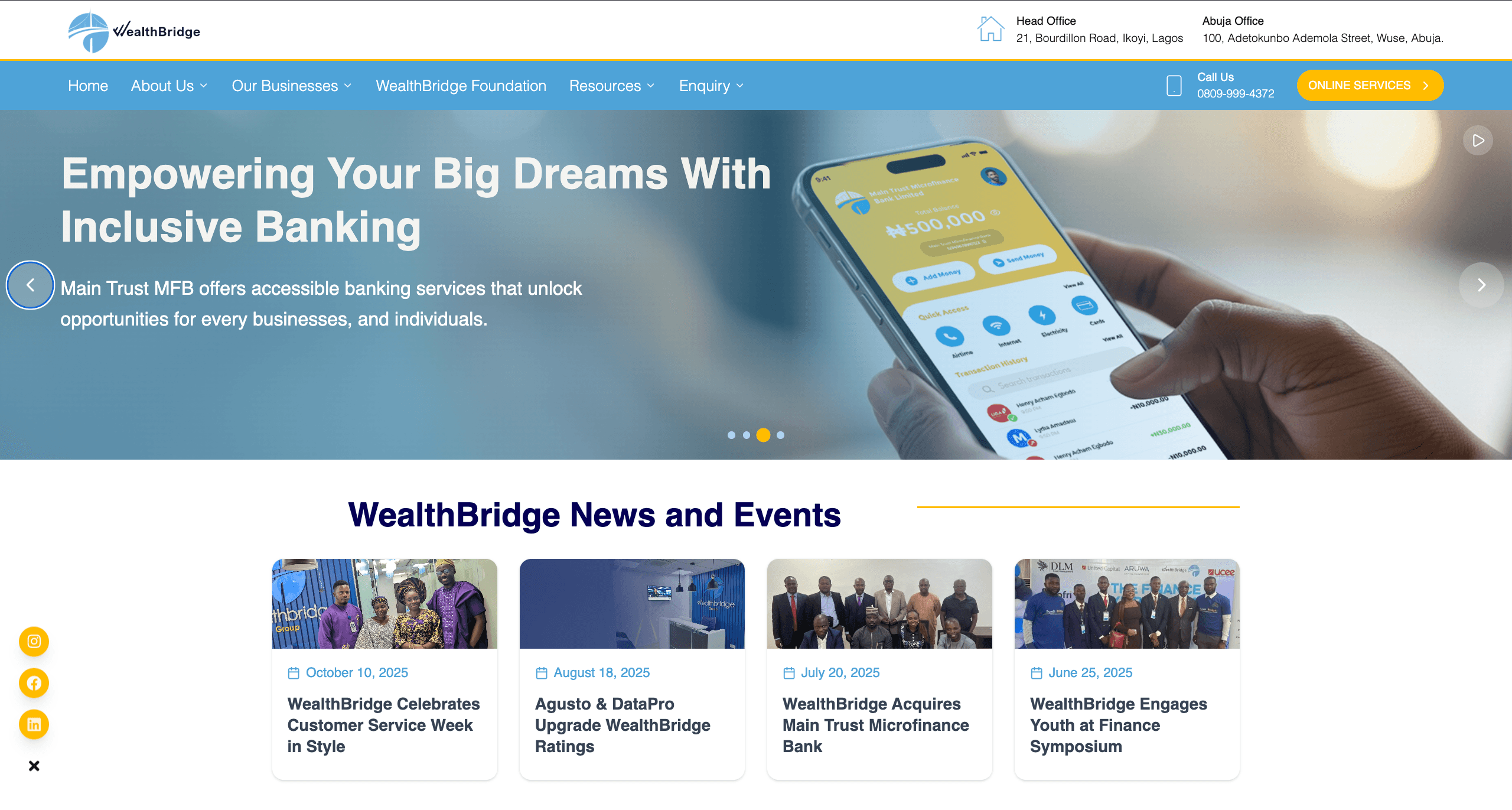
The WealthBridge group website homepage
PageSpeed 90+Mobile score, up from 74 on the WordPress site
By the numbers
PageSpeed, mobile
74→90+
Image weight
−87%
Unused fonts cut
440 KB
Blog posts shipped
12+
Site updates shipped
30+
01 / The problem

The brief

The group website ran on WordPress. It was slow on the phones most visitors use, every content change went through a developer, and releases were files uploaded by hand.

Worse, a sitemap bug had quietly hidden the news section from search engines, so the articles management cared most about weren't being found at all.

“Fast for visitors, easy for editors, boring to deploy.”The three goals for the rebuild
02 / The stack

The line-up

Eleven pieces in a 4-3-3: content at the back, search visibility up front. Tap one to see its job.

4-3-3 · ATTACKING ↑
No.7 · AttackNext.jsThe new frontend, rebuilt from WordPress page by page with the App Router.
03 / Architecture

Two pipelines

One for content, one for code. Neither needs a developer to log in to a server.

A · How content goes live

  1. 01Editor publishesIn Sanity Studio
  2. 02Webhook firesSanity → Next.js
  3. 03Page revalidatesISR, that page only
  4. 04Cache serves itNginx, static speed
  5. 05Visitor sees itSeconds, not a deploy

B · How code goes live

  1. 01Merge to mainPull request reviewed
  2. 02CI buildsGitHub Actions + WebP images
  3. 03Deploy lockNo two releases collide
  4. 04Ship + restartBuild to server, PM2 restart
  5. 05Health checkIs the site up?
  • PassPurge the Nginx cache. Live.
  • FailRoll back to the last good build, automatically.
  • Dry runEvery step without touching production.
04 / Performance

Where 16+ points came from

PageSpeed · mobile
WordPress74
Next.js + Sanity90+
  1. −87%

    Images, resized at build time

    Source images went from 41.8 MB to 5.6 MB, then CI generates resized WebP versions for every screen size.

    41.8 MB5.6 MB
  2. ISR

    Static pages that stay fresh

    Pages are served from cache and rebuilt only when Sanity says their content changed, instead of rendering on every request.

  3. LCP

    The hero image loads first

    The largest image on the page is prioritised, so the main content paints sooner.

  4. −440 KB

    Unused fonts removed

    Font files nobody was rendering, deleted from every page load.

05 / Trade-offs

Key decisions

DECISION 01

Resize images in CI, not on the server

The production server's CPU couldn't run sharp, the library behind Next.js image optimisation. So GitHub Actions resizes every image to WebP at build time, and the server only ever serves finished files.

TRADE-OFF · Builds take longer, and a new image size means a new build.

DECISION 02

Revalidate on publish, not on a timer

Sanity calls a webhook when an editor publishes, and Next.js rebuilds just that page. Visitors get static-page speed; editors see their change in seconds.

TRADE-OFF · One more moving part: a webhook that fails has to be noticed, or a page stays stale.

DECISION 03

Rehearse the pipeline on a replica

Before the new pipeline touched production, I ran it against a Docker replica of the server. It caught two bugs that would have taken the site down.

TRADE-OFF · Time up front to build the replica and keep it close to the real server.

DECISION 04

Every deploy can undo itself

A deploy lock stops two releases colliding, a health check runs after every restart, a failed check rolls back automatically, and dry-run mode tests all of it safely.

TRADE-OFF · More pipeline code to own, test and document.

06 / Search
  • sitemap.xml

    News back in search

    Fixed the sitemap bug that had hidden every news article from search engines.

  • application/ld+json

    Structured data

    JSON-LD for the organisation and articles, so search engines understand what each page is.

  • generateMetadata()

    A metadata fallback chain

    Page, then section, then site defaults: no page ships without a title and description.

  • Search Console

    Monthly reporting

    Reports to management show search visibility growing month on month.

07 / Outcome

The result

The site scores 90+ on mobile, the team publishes in Sanity without a developer, and a release is a merge to main.

Since the rebuild I've shipped more than 12 blog posts and 30 updates for management, each live within minutes of sign-off, and the news section is back in search.

What's next

  • The same stack and pipeline for the MainTrust public website, now in review.
  • A standalone Bridge Foundation website, in progress.
esc
Curriculum vitae

Moses Chukwudi Nwigberi · Résumé

The short version: WealthBridge, VisCorner, DITCOSoft, Pepnops and a few seasons of freelance.

Open the PDF